

I. Smart Fire Safety Market Background - Why Apartment Building Gas Detection Matters Globally
In the smart city era, fire safety can no longer be an isolated silo. Modern fire protection must integrate with building management systems, access control, CCTV, HVAC automation, elevator control, and government emergency response platforms. Wanlin Fire Control designs every device, gateway, and platform module with open architecture from day one. REST API, MQTT, Modbus, BACnet, and OPC-UA protocol support ensures that our fire safety ecosystem seamlessly connects with any building automation or smart city infrastructure your project requires.
Wanlin Fire Control, as a direct manufacturer of comprehensive smart fire safety solutions including the Apartment Building Gas Detection, is uniquely positioned to serve this global demand. With 15+ years of manufacturing experience, ISO9001:2015 certification, and exports to 50+ countries, Wanlin offers distributors and project buyers a competitive factory-direct partnership with genuine international certifications, complete OEM/ODM flexibility, and dedicated long-term support.
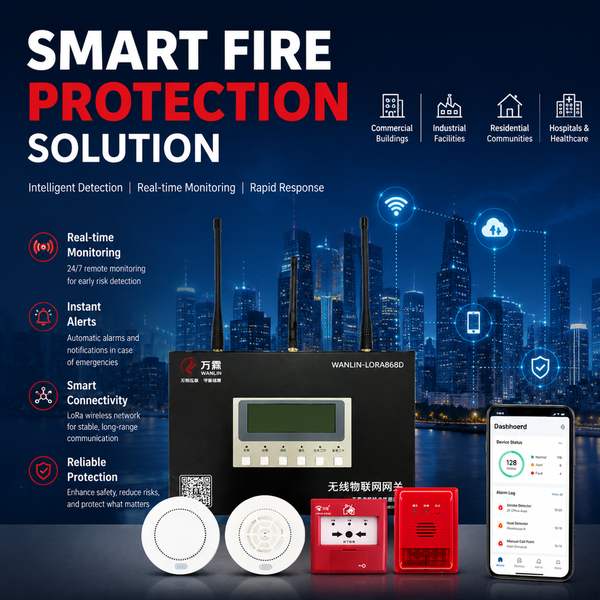
II. Technical Architecture and Capabilities of Apartment Building Gas Detection
The Apartment Building Gas Detection is engineered at Wanlin's ISO9001:2015 certified facility. It integrates IoT device management, cloud data processing, AI analytics, and multi-channel alerting into a unified ecosystem. Designed for scalability from single-building to city-wide deployments, the Apartment Building Gas Detection ships with complete international certification documentation for seamless import compliance and tender submission worldwide.
- IoT Connectivity: Multi-protocol support: 4G LTE Cat.1, NB-IoT, LoRa WAN, and WiFi. The apartment building gas detection ensures always-on cloud communication across all network conditions, enabling real-time monitoring from any location worldwide.
- Cloud Platform Integration: The apartment building gas detection connects to the Wanlin smart fire safety cloud platform with web dashboard and iOS/Android apps. Real-time device status, alarm history, compliance reports, and multi-site management from a single interface.
- AI-Powered Early Warning: Machine learning algorithms analyze sensor data patterns to identify pre-fire conditions before actual ignition. The apartment building gas detection reduces false alarms by 80% compared to conventional detectors while improving early detection rates.
- Multi-Channel Alerting: When the apartment building gas detection detects an anomaly, alerts are simultaneously sent via push notification, SMS, phone call, email, and in-app alarm. Up to 10 recipients per device ensure no alert is missed.
- Wireless Deployment: No wiring required. The apartment building gas detection installs in minutes with 3M adhesive or screws. Battery life up to 3 years (NB-IoT) or 5 years (LoRa). Ideal for retrofitting existing buildings without disruption.
- Temperature Range: Operating temperature -10C to +55C. IP54 dust and water resistance rating. The apartment building gas detection is suitable for indoor and semi-outdoor environments including warehouses, garages, and covered walkways.
- Compliance Certifications: CCCF (China), CE, RoHS, FCC, EN14604 (smoke), EN50194 (gas), EN54-7 (system). The apartment building gas detection ships with complete certification documentation for international tenders and import compliance.
- Scalable Architecture: From single-building deployment to city-wide networks of 100,000+ devices. The apartment building gas detection supports multi-tenant cloud architecture with hierarchical user permissions for distributed management.
- Open API Integration: REST API and MQTT protocol support. The apartment building gas detection integrates with BMS, CCTV, access control, HVAC, and government supervision platforms. Standard protocols: Modbus, BACnet, OPC-UA.
- Battery & Power Options: The apartment building gas detection supports DC3.6V lithium battery (3-year life), AC220V mains power with battery backup, and solar-powered options for remote locations. Low-battery alerts via cloud platform.
- Self-Diagnostics: Automatic self-test cycles every 24 hours. The apartment building gas detection reports device health, sensor sensitivity, battery status, and communication quality to the cloud platform. No manual inspection required.
- Fire Event Recording: Complete event log with timestamp, sensor readings, alert chain, and response actions. The apartment building gas detection provides audit-ready compliance documentation for insurance and regulatory authorities.
- Multi-Sensor Fusion: The apartment building gas detection supports combined smoke, heat, CO, and gas detection in a single device or networked array. Cross-validation across sensor types dramatically reduces false alarms while improving detection accuracy.
- OEM/ODM Customization: Custom branding on device housing, packaging, cloud platform UI, and mobile apps. The apartment building gas detection can be configured with partner-specific alert thresholds, communication protocols, and compliance standards.
III. Wanlin Fire Control - Your Direct Apartment Building Gas Detection Manufacturer
Wanlin Fire Control is a specialized smart fire safety manufacturer with 15+ years of production experience. Our 20,000+ sqm ISO9001:2015 facility with 200+ staff and 15+ R&D engineers produces the complete value chain: IoT devices, communication gateways, cloud platform, AI analytics, and user applications. Wanlin directly controls every production stage, we are a genuine manufacturer, not a trading company.
- Complete Ecosystem from One Manufacturer: The Apartment Building Gas Detection along with devices, connectivity, platform, analytics, and apps are all designed and manufactured in-house for guaranteed interoperability.
- Genuine International Certifications: CCCF, CE, RoHS, FCC, CE-RED. EN testing documentation available. All certificates are verifiable and shipped with orders.
- ISO9001:2015 Quality Management: 100% functional testing, NIST-traceable calibration, systematic QC at every production stage. Zero-defect commitment.
- 15+ R&D Engineers In-House: Cloud platform, AI algorithms, firmware, hardware, and mobile apps developed internally. 3-6 month innovation cycles.
- Scalable Cloud-Native Platform: Single building to 100,000+ device deployments. Multi-tenant architecture. 99.9% availability SLA.
- Comprehensive OEM/ODM for Apartment Building Gas Detection: Custom branding on device housing, packaging, platform UI, and mobile apps. Build your own fire safety brand on Wanlin's proven technology.
- Factory-Direct Pricing: 30-50% below premium international brands. 40-60% distributor margins achievable through direct-manufacturer economics.
- Flexible MOQ: Standard 100 units. OEM 500 units. Evaluation samples 5-20 units. Platform demo for qualified partners.
- Dedicated Partner Support: English-speaking account management, engineering technical support, marketing materials, product training, warranty service.
IV. Competitive Advantages - Apartment Building Gas Detection vs. International Brands
For fire safety distributors, system integrators, and project buyers, selecting a manufacturing partner for Apartment Building Gas Detection is a strategic decision affecting product quality, cost structure, margin profile, and long-term business competitiveness. When evaluating across technology capability, platform completeness, certification authenticity, pricing, OEM flexibility, and partnership quality, Wanlin Fire Control demonstrates clear competitive advantages over both premium international brands and fragmented device-only manufacturers.
| Comparison | Wanlin | Honeywell | Siemens |
|---|---|---|---|
| Price Level | Factory-direct | Premium | Premium |
| IoT Connectivity | 4G/NB-IoT/LoRa | WiFi/Proprietary | Proprietary |
| Cloud Platform | Included free | Annual license fee | Annual license fee |
| OEM/ODM | Full support | Limited | No |
| MOQ | 100 units | High | High |
| Innovation Cycle | 3-6 months | 2-3 years | 2-3 years |
| Cost Advantage | 30-50% lower | Baseline | Baseline |
Additional Apartment Building Gas Detection Differentiating Advantages:
- Complete Vertical Integration: Wanlin manufactures devices AND develops the cloud platform AND builds the AI algorithms AND creates the mobile apps. Most competitors excel in one layer but partner for others, creating integration gaps and multi-vendor accountability issues.
- Platform Without License Fees: The Wanlin cloud platform (web + iOS + Android) is included with device purchases at no recurring license fee. Premium competitors often charge substantial annual platform subscription fees per device or per building.
- Specialized Vertical Solutions: Pre-configured fire safety solutions for heritage buildings, campuses, elderly care facilities, industrial parks, hospitals, and commercial complexes, with tailored dashboards and compliance reporting.
- Open API Architecture: REST API and MQTT interfaces for integration with BMS, CCTV, access control, and government supervision platforms. No proprietary lock-in.
- Rapid Innovation: 15+ in-house R&D engineers with 3-6 month feature development cycles vs. multi-year corporate product cycles at multinationals.
- Environmental Responsibility: ISO14001 certified, RoHS/REACH compliant, FSC-certified packaging, conflict minerals policy.
V. Frequently Asked Questions About Apartment Building Gas Detection
Q1: How long does it take to deploy Apartment Building Gas Detection in a typical building?
A standard 50-unit deployment of Apartment Building Gas Detection in a mid-rise residential or commercial building takes approximately 1-2 days. Wireless installation requires no cabling, conduit, or electrical work. Each device mounts in under 5 minutes. Cloud platform configuration and user account setup adds 2-4 hours. Total deployment is 80% faster than wired fire alarm systems.
Q2: What training is required for Apartment Building Gas Detection installation and maintenance?
Wanlin provides comprehensive training materials: installation video tutorials (30 minutes), technician certification course (online, 4 hours), cloud platform administrator guide, and troubleshooting flowcharts. No specialized electrical contractor license required for battery-powered IoT devices. Advanced training available via video conference for large project teams.
Q3: How does Apartment Building Gas Detection perform in high-humidity or dusty environments?
Apartment Building Gas Detection IP54-rated enclosure protects internal electronics from dust ingress and water spray. For high-humidity environments (kitchens, laundries, tropical climates), the device includes humidity-compensated sensor algorithms that maintain detection accuracy. Condensation-resistant lens coating prevents false alarms from moisture accumulation on the photoelectric chamber.
Q4: Can Apartment Building Gas Detection be used in multi-story buildings with thick concrete walls?
Yes. Apartment Building Gas Detection with 4G or NB-IoT connectivity operates independently of building structure, as cellular signals penetrate concrete walls effectively. For LoRa deployments, mesh network repeaters extend range through challenging building geometries. Each device communicates directly with the cellular network, eliminating in-building signal distribution concerns.
Q5: What happens if Apartment Building Gas Detection detects a fire event?
When Apartment Building Gas Detection triggers: (1) local audible/visual alarm activates immediately (85dB siren, flashing LED), (2) cloud platform receives the alarm within 5 seconds, (3) multi-channel alerts sent to up to 10 designated recipients (push, SMS, phone call, email), (4) event logged with timestamp and sensor data, (5) optional integration with building automation for HVAC shutdown and door release.
Q6: How is Apartment Building Gas Detection maintained over its operational lifetime?
Apartment Building Gas Detection requires minimal maintenance: automatic self-test every 24 hours reports device health to cloud platform, battery life monitoring with 30-day advance low-battery alert, sensor sensitivity auto-calibration, and OTA firmware updates. Physical inspection recommended every 6 months (visual check only). No annual sensor replacement required for the first 3 years.
Q7: Can Apartment Building Gas Detection be integrated with smart building management systems (BMS)?
Yes. Apartment Building Gas Detection supports REST API and MQTT integration with BMS platforms. Standard protocols (Modbus, BACnet, OPC-UA) enable seamless data exchange with HVAC, access control, CCTV, elevator, and lighting systems. The cloud platform provides webhook callbacks for real-time event integration. Custom integration development available for project-specific requirements.
Q8: What deployment scenarios is Apartment Building Gas Detection best suited for?
Apartment Building Gas Detection excels in: retrofit installations (no wiring needed), multi-site distributed monitoring (cloud platform centralizes management), temporary installations (construction sites, events), hard-to-wire environments (heritage buildings, historical sites), remote locations (rural facilities, offshore platforms), and rapid deployment scenarios (emergency fire safety upgrades, post-incident compliance).
VI. Client Success Stories - Apartment Building Gas Detection Deployed Worldwide
Wanlin Fire Control has supplied professional fire safety products and platforms to distributors, system integrators, property developers, government agencies, and facility operators in over 50 countries. The following representative case studies demonstrate successful deployments across diverse markets and applications, illustrating the real-world impact of our Apartment Building Gas Detection solutions.
Smart Fire Safety for Hotel Chain - Indonesia
Location: Bali, Indonesia
A 28-property hotel chain across Bali, Jakarta, and Surabaya deployed 7,200 Wanlin IoT smoke detectors, 560 gas detectors in kitchen areas, and 280 electrical fire monitors in electrical rooms. The cloud platform provides corporate-level monitoring across all properties with automated compliance reporting for Indonesian fire safety regulations. Guest safety alerts are integrated with the hotel PMS system for rapid room-specific response. The chain achieved a 35% reduction in fire safety insurance premiums and passed all regulatory inspections without deficiency.
University Campus Fire Safety IoT - United Arab Emirates
Location: Abu Dhabi, UAE
A major university in Abu Dhabi with 15,000 students deployed 4,200 Wanlin IoT fire safety devices across dormitories, laboratories, lecture halls, and dining facilities. The integrated solution combines NB-IoT smoke detectors, heat detectors, gas detectors in chemistry labs, and electrical fire monitors in server rooms. The cloud platform with AI analytics provides real-time campus-wide monitoring, automated compliance reporting for UAE Civil Defense, and mobile app alerts to 45 campus safety officers. The system achieved 100% device uptime over 18 months of operation.
Hospital Fire Safety Monitoring - South Africa
Location: Johannesburg, South Africa
A 600-bed hospital in Johannesburg deployed 1,800 Wanlin IoT fire safety devices including smoke detectors in patient wards, gas detectors in laboratory and kitchen areas, and electrical fire monitors in the data center and mechanical plant rooms. The cloud platform integrates with the hospital's building management system and provides priority alerting protocols for oxygen-rich environments. The deployment met South African National Standards (SANS 10139) requirements and reduced fire safety system maintenance costs by 45% compared to the previous wired system.
VII. Partnership Models - Join Wanlin's Global Apartment Building Gas Detection Distribution Network
Wanlin Fire Control is actively expanding our global distribution network for Apartment Building Gas Detection and the complete smart fire safety ecosystem. The market is experiencing rapid growth driven by IoT adoption, AI integration, regulatory mandates for connected fire protection, and urbanization. We welcome long-term partnerships with fire safety equipment distributors and wholesalers, system integrators and fire protection engineering companies, electrical and building materials distributors, property developers and facility management companies, smart city and government procurement partners, and e-commerce entrepreneurs.
- Exclusive Territory Distribution: Protected territory with contractual exclusivity. Priority factory-direct pricing. Co-investment in market-specific certifications. Marketing support and dedicated account management.
- Non-Exclusive Distribution: Competitive pricing without territorial exclusivity. Ideal for market testing, niche segments, or complementary product lines.
- OEM / Private Label Manufacturing: Wanlin manufactures Apartment Building Gas Detection under YOUR brand. Your logo on devices, packaging, platform UI, and mobile apps. Build your own fire safety brand equity.
- Project-Based Supply: For large-scale Apartment Building Gas Detection deployments: smart campus projects, elderly care facility networks, commercial complex upgrades, industrial park installations. Volume pricing and dedicated project management.
- Government Tender Partnership: Joint pursuit of government fire safety and smart city infrastructure tenders. Complete certification documentation and manufacturing capacity guarantees.
- Platform-as-a-Service Partnership: White-label SaaS solution for technology companies and system integrators. Your brand on the platform, Wanlin handles backend infrastructure.
- E-Commerce and Dropshipping: Wholesale pricing, white-label options, comprehensive product content for online listings, and dropshipping fulfillment worldwide.
VIII. Conclusion - Your Strategic Apartment Building Gas Detection Manufacturing Partner
Wanlin Fire Control is your strategic manufacturing partner for Apartment Building Gas Detection and the complete smart fire safety ecosystem. By sourcing directly from our ISO9001:2015 certified factory, you receive: professional-grade IoT fire safety devices, a complete cloud platform with AI analytics at no license fee, genuine international certifications (CE, FCC, RoHS, CCCF, EN), factory-direct pricing delivering 30-50% cost advantage, comprehensive OEM/ODM manufacturing for building your own brand, and dedicated long-term partner support with 15+ years of export experience. Whether you are an established fire safety distributor, a system integrator, an entrepreneur building a new brand, a property developer, or a government agency, Wanlin is prepared and committed to being your quality-focused, competitively priced, innovation-driven fire safety manufacturing partner.
Contact Wanlin Fire Control Today:
Email: wanlinfirecontrol@163.com
Export Service Hotline / WhatsApp: +8613261677119
Website: www.wanlinfire.com
Factory-direct pricing, professional quality, complete smart fire safety ecosystem, worldwide delivery - partner with Wanlin Fire Control for your Apartment Building Gas Detection manufacturing and supply needs.