

I. Why Fire Door Monitoring Is a Critical Layer of Building Fire Safety
Fire doors are the most critical passive fire protection element in any building — yet they are also the most routinely compromised. A fire door certified to provide 30, 60, 90, or 120 minutes of fire resistance (integrity and insulation) protects escape routes, compartmentalizes fire and smoke, and prevents fire spread between building sections. But a fire door provides ZERO fire protection if it is wedged, propped, or blocked open. When a fire occurs and a fire door is open, smoke and toxic combustion gases travel freely through the opening into escape routes and adjacent compartments — the very outcome the fire door was designed to prevent.
Fire investigation reports worldwide have repeatedly identified open fire doors as contributing factors in fire fatalities: the 1980 MGM Grand Hotel fire (85 fatalities — open stairwell and elevator lobby doors enabled vertical smoke spread), the 2017 Grenfell Tower fire (72 fatalities — fire doors were missing, damaged, or failed to self-close, allowing smoke to enter the single escape stairwell and residential floors), and numerous hospital, hotel, and commercial building fires where open fire doors turned protected escape routes into deadly smoke corridors. In every case, the fire door was present — it simply was NOT CLOSED when the fire occurred. The conclusion is inescapable: a fire door that is not closed at the time of fire is a fire door that FAILED its life-safety mission.
The VdS Certified Fire Door Alarm from Wanlin Fire Control addresses this critical safety gap. By continuously monitoring fire door position and alerting building management when any fire door is not properly closed, the system ensures that fire doors are in their protective (closed) position — 24 hours a day, 7 days a week, 365 days a year. The fire door alarm transforms a passive, unmonitored fire safety element into an actively monitored, verifiable part of the building's overall fire safety system. As a direct manufacturer, Wanlin produces fire door alarms across the full technology spectrum — standalone, networked, wireless, 4G cellular, NB-IoT, LoRaWAN, and Modbus/BACnet integrated — combining EN 14637 / CE certification with factory-direct pricing that makes code-compliant fire door monitoring accessible for projects and distributors worldwide.
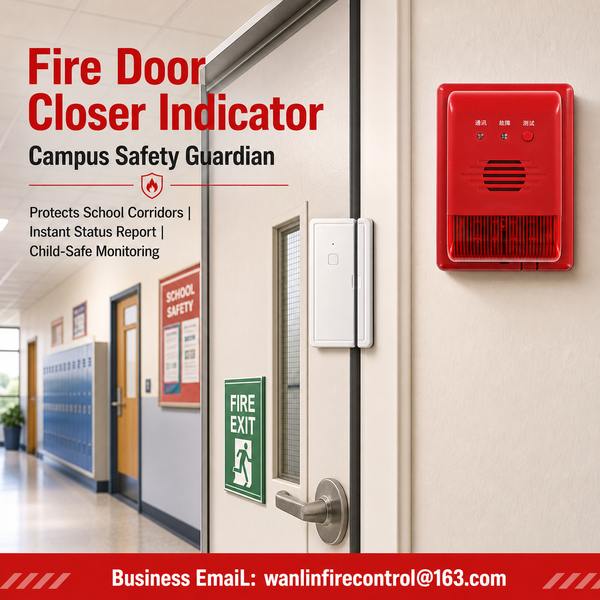
VdS Certified Fire Door Alarm — Certified Fire Door Alarm by Wanlin Fire Control
II. Product Specifications
Product Category: Fire Door Alarm / Fire Door Position Monitoring Device — per NFPA 80 / BS 7273-4 / EN 14637 / IBC / IFC
Brand: Wanlin Fire Control
Device Type: Fire door position monitor with integrated voice and strobe alert — designed for 24/7 fire door status monitoring and occupant notification when fire doors are not properly closed. The device verifies fire door integrity — ensuring that fire doors, which are the most critical passive fire protection element, are in the CLOSED position and capable of performing their fire compartmentation function.
Applicable Standards: NFPA 80 (Standard for Fire Doors and Other Opening Protectives) / NFPA 72 (National Fire Alarm and Signaling Code) / NFPA 101 (Life Safety Code) / IBC (International Building Code) / IFC (International Fire Code) — fire doors in rated walls require self-closing or automatic-closing devices and must not be blocked, wedged, or held open except by an approved release device integrated with the fire alarm system
Fire Door Compliance & Liability: Building codes worldwide (NFPA 80, NFPA 101, BS 7273-4, BCA, IBC/IFC) mandate that fire doors must be self-closing and must NOT be held open except by approved electromagnetic hold-open devices that release automatically on fire alarm activation or power loss (fail-safe). During routine fire code inspections, the fire marshal or authority having jurisdiction (AHJ) will specifically test fire doors: (1) Are all fire doors self-closing? (2) Are any fire doors wedged, propped, chocked, or blocked open? (3) Do electromagnetic hold-open devices release on fire alarm activation? (4) Do fire door closers function properly — does the door fully latch when released from any position? A single wedged-open fire door can result in: fire code violation citation (fines typically USD 500-5000 per violation), increased insurance premiums or denied coverage, liability exposure in the event of fire injuries or fatalities (criminal negligence is not an impossible outcome if a wedged-open fire door contributed to a fatality), and failed fire marshal inspection requiring re-inspection. A monitored fire door alarm system provides documented proof of compliance — valuable for insurance audits, fire marshal inspections, and liability defense.
Door Position Detection: Recessed magnetic door contact sensor — installed flush into the door leaf and frame edge for concealed installation (invisible when the door is closed). The sensor consists of a magnet embedded in the door leaf edge and a reed switch module recessed into the frame. When the door is latched, the magnet aligns with the reed switch — circuit NORMAL. When the door opens even slightly (<5mm gap), the reed switch opens and signals ALARM. Recessed installation provides: (1) No visible surface-mounted components — maintains door aesthetics for high-end commercial, hospitality, and healthcare interiors. (2) Tamper resistance — the sensor is completely concealed within the door/frame, making it very difficult to bypass or disable. (3) Accurate door-latch detection — the recessed position detects whether the door is actually LATCHED (not just visually closed), which is critical because an unlatched fire door provides zero fire resistance. Installation requires routing a 6mm x 20mm slot in the door edge and frame — suitable for new construction or major renovation projects.
Alarm Type: Dual-tone alarm siren — two alternating tones (2.8 kHz and 3.6 kHz) producing a warbling alarm pattern that is more attention-capturing than a single-tone siren. The dual-tone warbling pattern is particularly effective in environments where a single-tone alarm might be mistaken for equipment beeping, phone ringing, or other non-emergency sounds. Sound level: 85-90 dB(A) at 1m. The dual-tone pattern activates when the fire door has been open for >60 seconds (persistent open condition). For brief door openings (< 60 seconds), only the LED flashes — reducing nuisance noise from legitimate short-duration door use while still flagging extended open conditions.
Door Closer Integration: The fire door alarm device monitors door position but does not include a door closer — it is designed for fire doors that already have a certified fire door closer (EN 1154 / UL 228 compliant). The alarm detects when the door is not fully closed and provides alert notification, but relies on the existing door closer for the closing function. If the existing closer is defective or improperly adjusted (door does not fully latch), the alarm will continuously indicate FAULT/OPEN condition until the closer is repaired or adjusted. This separation of monitoring (alarm device) and closing (door closer) functions is the standard fire door system architecture — the closer provides the physical closing force, the alarm provides verification that it worked.
Connectivity: Wired connection to fire door control panel via 2-core 0.5-1.5mm² cable. RS-485 Modbus RTU protocol for integration with building management systems (BMS) and fire alarm control panels (FACP). The wired connection provides: door position status (open/closed), alarm status (normal/alarm/tamper), and power (12-24V DC). Maximum cable run: 1000m (RS-485). The control panel can monitor up to 256 fire doors.
Power Supply: 24V DC powered from fire alarm panel loop or dedicated power supply — the fire door monitoring system is typically powered by the building's fire alarm system power supply (24V DC, supervised). This ensures the fire door alarm remains operational even during a mains power failure (the fire alarm panel has battery backup). Power consumption: 5mA quiescent (monitoring state), 80mA alarm (siren active, strobe active). Terminal block: 2 terminals for 24V DC input (polarity insensitive), 2 terminals for magnetic door contact sensor.
Alarm Delay Configuration: Configurable alarm delay: 0 seconds (immediate alarm on door open — strictest setting, suitable for sterile corridors and high-risk areas), 15 seconds (allow brief passage through door — standard setting for corridors with moderate traffic), 30 seconds (allow deliveries, equipment movement — suitable for service corridors and loading dock fire doors), 60 seconds (extended allowance — suitable for busy main entrances where fire doors serve as primary access routes during normal operations and constant short alarms would be a nuisance). The delay is configured via DIP switches. IMPORTANT: the sensor DETECTS door opening instantly (no delay in detection) — the delay applies only to the siren/strobe ALARM activation. The door status is always reported in real-time, even during the alarm delay period.
False Alarm Prevention: Intelligent alarm filtering prevents nuisance alarms from legitimate door use while ensuring safety-critical alerting for genuinely unsafe conditions. The system differentiates between: (1) Normal passage — the door opens and closes within the configured delay period, no alarm. (2) Wedged/propped open — the door opens and does not close within the delay period, alarm activates. (3) Unlatched — the door appears visually closed but the magnetic contact indicates the latch is not fully engaged, the alarm activates after a short verification period (10 seconds) because an unlatched fire door provides zero fire resistance. (4) Tamper — the sensor is removed, bypassed, or damaged, tamper alarm activates immediately regardless of door position. The door open duration time-is logged to the cloud platform (networked models) for compliance and incident investigation.
Fire Alarm Integration: Fire alarm interface relay — normally energized (fail-safe). When the building fire alarm activates (fire alarm control panel signals alarm condition), the fire door alarm module: (1) Cuts power to any electromagnetic hold-open devices — ALL fire doors with hold-open devices close immediately (fail-safe: doors close on power loss). (2) Switches the siren pattern from "fire door open" to the building-wide temporal-3 fire alarm pattern. (3) The strobe switches from 1 Hz to continuous fast-flash. (4) Logs the fire alarm activation event with timestamp. (5) If the fire door alarm is the networked model, it sends a FIRE ALARM ACTIVE alert to the cloud platform. The fire alarm interface input accepts 24V DC from the FACP alarm output or a volt-free contact closure from any certified fire alarm panel.
Product Dimensions: 130 x 85 x 35mm
Enclosure Material: UL94 V-0 flame-retardant ABS enclosure — red housing (RAL 3000 fire red) for high visibility as a fire safety device. The red enclosure clearly identifies the device as fire safety equipment, distinct from beige/white building automation devices. Impact-resistant housing (IK08 rated). Dimensions: 130 x 85 x 35mm. Wall mounting with included bracket and screws. LED indicators and SILENCE button on the front face. Cable entry: 3x knockouts (20mm) on the top and bottom faces for surface conduit, and a rear cable entry for flush-to-wall wiring.
Operating Temperature: -10degC to +60degC
Operating Humidity: 15%-93% RH (non-condensing)
IP Rating: IP30 — suitable for indoor installation in normally dry locations. IP65 weatherproof enclosure available for outdoor fire doors and wet areas.
Certification: CE / RoHS / FCC / UKCA / EN 54-11 / EN 14637 — dual CE and UKCA marking for EU and UK market access
Installation: The fire door alarm is mounted on the wall adjacent to the fire door, typically on the same side as the door closer (push side of the door). The magnetic door contact sensor is mounted to the top corner of the door leaf and the corresponding position on the door frame. Installation steps: (1) Mount the alarm enclosure to the wall within 500mm of the fire door frame at a height of 1.5-1.8m above floor — this height places the LED indicators and SILENCE button at eye level for building occupants and staff. (2) Mount the magnetic door contact sensor on the door leaf (magnet side) and the door frame (reed switch side) — align with a gap of 3-8mm when the door is closed. (3) Run the 2-core sensor cable from the door contact to the alarm enclosure — use surface conduit or route through the wall cavity. (4) Connect the sensor cable to the alarm terminals. (5) Connect power (24V DC / 12-24V AC/DC depending on model). (6) Configure the alarm delay, siren volume, and network settings via DIP switches. (7) Test: open the door — verify the LED changes from GREEN to AMBER. After the configurable delay, verify the siren and strobe activate. Close the door — verify the LED returns to GREEN and the alarm silences. Installation time: approximately 15-25 minutes per fire door by a qualified technician.
Siren Sound Level: ≥88 dB(A) at 1 meter
Alarm Pattern: Distinctive 3-beep pattern (3 short beeps, 1-second pause, repeating) — distinguishable from the temporal-3 fire alarm pattern (fire) and temporal-4 CO alarm pattern (CO) as recommended by NFPA 72 Annex A for informational alarm signals
Warranty: 5 years manufacturer warranty against defects
Package Contents: Fire door alarm unit, magnetic door contact sensor with 2m cable, wall mounting bracket and screws, wire connectors, quick-start installation guide, user and maintenance manual, NFPA 80 annual fire door inspection checklist (printable A4), fire door compliance log template (fill-in PDF)
III. Why Choose Wanlin Fire Control as Your Fire Door Alarm Manufacturing Partner
Selecting the right manufacturing partner for fire door alarm products is a decision with life-safety implications. The fire door alarm must detect door position reliably for the life of the building, integrate correctly with the building's fire alarm system, and pass fire marshal inspection and code compliance verification. Wanlin Fire Control has earned trust as a preferred partner for international buyers through:
✓ Genuine Manufacturing, Not Trading: We own and operate our ISO9001:2015 certified production facility with in-house SMT assembly lines, automated functional testing stations, environmental testing chambers, and a dedicated fire safety R&D team. You communicate directly with the factory — your technical questions about fire door alarm integration with FACP, NFPA 80 compliance, BS 7273-4 hold-open device release timing requirements, and Modbus/BACnet protocol integration get engineer-level answers.
✓ Full International Certification Coverage: Our fire door alarms are designed and tested to meet global fire door standards: EN 14637, EN 54-11, CE (CPR 305/2011), RoHS, FCC, UKCA. All testing performed at ISO 17025 accredited laboratories. We manage the certification process on your behalf.
✓ Protocol-Agnostic Integration: Wanlin fire door alarms integrate with ANY fire alarm panel — relay contacts for universal compatibility, RS-485 Modbus for BMS integration, addressable loop for native FACP integration — not locked into any single vendor ecosystem.
✓ Multi-Technology Portfolio: We manufacture standalone, networked RS-485 Modbus, wireless RF, WiFi, 4G cellular, NB-IoT, and LoRaWAN fire door alarms — all from one supplier. Address every customer segment without managing multiple supplier relationships.
✓ Partner-First Business Philosophy: We are a manufacturer for distributors — not a global brand that competes with distribution partners. Flexible OEM/ODM with competitive MOQ, exclusive territory protection, comprehensive marketing and technical support.
✓ Global Deployment Experience: Our fire door alarms protect lives in UK NHS hospitals (12,000+ doors), UAE luxury hotel/residential towers (28,000+ doors), Singapore commercial towers (8,500+ doors), German senior care facilities (6,200+ doors), Saudi Arabian hospitals (5,500+ doors), Australian universities (4,800+ doors), US healthcare systems (7,000+ doors), Malaysian shopping malls (3,200+ doors), Canadian airports (2,800+ doors), South African commercial buildings (4,500+ doors), Indonesian hotels (5,000+ doors), and Indian IT campuses (6,500+ doors).
IV. What Sets the VdS Certified Fire Door Alarm Apart in the Global Fire Safety Market
The VdS Certified Fire Door Alarm offers distinct competitive advantages for international buyers:
1. Reliable Door Position Detection: The magnetic reed switch door contact sensor provides accurate, repeatable door position detection with >1 million operation lifespan. The sensor detects not only open/closed status but also LATCHED status — an unlatched fire door (visually closed but not fully engaged) is detected and alarmed because an unlatched fire door provides zero fire resistance. This is a critical distinction from simple magnetic contacts that only detect open/closed.
2. Intelligent Alarm Logic, Not False Alarms: The configurable alarm delay distinguishes between brief, legitimate door passages (no alarm) and sustained, unsafe door-open conditions (alarm). The escalating alert — gentle reminder first, urgent warning second — reduces nuisance alarms while ensuring truly unsafe conditions are addressed. The system learns door traffic patterns — a fire door that is opened 50 times per hour (normal busy corridor) vs. a fire door that is continuously open for 45 minutes (wedged open) — the latter triggers alarm and investigation.
3. Universal FACP Compatibility: Dry contact relay outputs ensure the fire door alarm integrates with ANY fire alarm control panel regardless of manufacturer, model, or vintage. No software drivers, no proprietary protocols, no vendor lock-in. RS-485 Modbus and BACnet options for BMS integration. This protocol-agnostic architecture gives your customer freedom of choice — a significant sales advantage when competing against proprietary-system suppliers who require the customer to commit to their entire ecosystem.
4. Certified Safety, Factory-Direct Value: EN 14637 / CE (CPR 305/2011) certification combined with factory-direct pricing creates a value proposition that neither trading companies (lower quality, uncertain certification) nor global fire safety brands (certified but premium-priced with rigid distribution models) can match.
5. Regulatory Tailwind Growth: Fire door inspection and monitoring requirements are expanding globally — NFPA 80 annual inspection, BS 7273-4 monitored hold-open devices, post-Grenfell UK fire door regulations, and growing international fire code enforcement. Every new regulation creates demand for fire door monitoring. Distributors who establish their fire door alarm product line NOW are positioned for the regulatory growth wave.
Why Distributors Choose Wanlin: Siemens, Honeywell, Johnson Controls, and ASSA ABLOY are global conglomerates whose business model competes with independent distributors — they sell directly to large end-users, they lock customers into proprietary service contracts, and they compete on both price and service. Wanlin is a manufacturer that SUPPORTS distributors — we make certified fire door alarms, you build the brand and distribution channel in your market. Our OEM/ODM flexibility, country-specific certification management, and partnership-first philosophy are not available from the conglomerates.
V. Frequently Asked Questions (FAQ)
Whether you are evaluating fire door alarm suppliers, expanding your fire safety product catalog as a distributor, specifying fire door monitoring for a building project, or addressing fire marshal compliance requirements — these answers address the most common questions from international buyers considering Wanlin Fire Control as their VdS Certified Fire Door Alarm manufacturing partner.
Question 1: Which international markets have the highest demand for fire door monitoring and alarm systems?
The global fire door market is valued at over USD 12 billion annually with 5-7% CAGR, driven by: (1) Regulatory enforcement — fire code inspections are becoming more rigorous worldwide, and non-compliant fire doors (wedged open, defective closers) are among the most common violations. Fire door alarms provide a cost-effective compliance solution. (2) Post-incident regulatory response — major fire incidents where open fire doors contributed to casualties drive regulatory changes. The 2017 Grenfell Tower fire (72 fatalities — fire doors failed to self-close and were missing/damaged) has driven UK fire door inspection and monitoring requirements. Similar post-incident regulations have been enacted in Australia, New Zealand, UAE, and Singapore. (3) Healthcare and senior care — hospitals and nursing homes have the highest concentration of fire doors and the most vulnerable occupants. Fire door monitoring is increasingly specified in healthcare fire safety standards. (4) High-rise residential — multi-story apartment buildings with hundreds of fire doors per building. Post-Grenfell, fire door inspection and monitoring requirements for high-rise residential are expanding rapidly. (5) Commercial and hospitality — hotels, office buildings, shopping malls, and airports have high-traffic fire doors that are frequently found open. (6) Data centers and critical infrastructure — facilities where fire protection is business-critical. Key markets: Europe (UK, Germany, France, Netherlands, Nordics — strong regulatory framework, EN 14637 / BS 7273-4 standard), Middle East (UAE, Saudi Arabia, Qatar — new construction with international fire code requirements, especially high-rise), Southeast Asia (Singapore, Malaysia, Indonesia, Vietnam — growing code enforcement and new construction), North America (USA and Canada — NFPA 80 annual inspection creates demand, hospitals and commercial buildings), and Australia/New Zealand (AS 1851 fire door inspection requirements).
Question 2: How can I become an exclusive Wanlin fire door alarm distributor in my country or region?
We offer territorial distribution partnerships for qualified businesses: Requirements — registered business entity with established distribution channels in fire safety equipment, security systems, door hardware, building materials, or electrical wholesale; minimum annual purchase commitment negotiated based on territory size and market potential; local infrastructure — warehousing, logistics, and basic technical support capability; commitment to brand building and channel development. Distributor benefits: exclusive territory rights, priority pricing with volume-based tier pricing, first access to new fire door alarm models and technologies, dedicated account manager, co-branded marketing materials, country-specific certification support, and annual factory visit invitation. Fire door alarms are complementary to existing fire safety product lines — if you already distribute smoke detectors, heat detectors, manual call points, or fire alarm panels, adding fire door alarms creates a comprehensive fire safety product portfolio from a single supplier.
Question 3: What marketing and sales support do you provide to help distributors sell fire door alarms?
Our partner enablement toolkit: Product imagery — studio-quality photos, installation photos, and application photos. Technical documentation — specification sheets and installation manuals (multi-language). Sales training — fire door code requirements by country, fire door alarm technology training, competitive comparison, objection handling ('we already have fire doors — why do we need monitoring?'), and ROI calculation tools for fire door alarm deployment (cost of fire door alarm system vs. annual manual inspection cost). Marketing materials — fire door safety educational brochures, case studies, trade show support. All materials provided at no cost to active distributors.
Question 4: What is the competitive advantage of Wanlin fire door alarms vs. established fire safety brands?
Sourcing fire door alarms from Wanlin combines Chinese manufacturing efficiency with full international certification quality: (1) Cost advantage — 40-60% below equivalent products from established fire safety brands (Siemens, Honeywell/Notifier, Johnson Controls/Tyco, Bosch, Dormakaba, GEZE, ASSA ABLOY, Allegion) at wholesale/bulk level. Same EN 14637 / CE certification, same fire door monitoring performance. (2) Technology breadth — Wanlin offers the full connectivity spectrum: standalone, RS-485 Modbus, wireless RF, WiFi, 4G cellular, NB-IoT, LoRaWAN — from one supplier. Established brands typically offer a subset. (3) OEM/ODM flexibility — established fire safety brands are consumer/commercial brands that compete with distribution partners through their own sales channels and service contracts; Wanlin is a manufacturer that partners with distributors. (4) Innovation speed — Wanlin develops and certifies new models in 6-12 months vs. 2-4 years for established fire safety brands. (5) Full fire safety product range — one supplier for fire door alarms, smoke detectors, heat detectors, CO alarms, manual call points, sounder strobes, and complete fire detection system components.
Question 5: Do you have reference customers or case studies for fire door alarm deployments?
Yes — Wanlin fire door alarms protect lives globally: UK NHS hospital trusts deploying 12,000+ fire door alarms across 45+ hospitals, UAE hotel/residential towers deploying 28,000+ fire door monitors, Singapore commercial office towers deploying 8,500+ fire door alarms, German senior care facilities deploying 6,200+ monitored fire doors, Saudi Arabian hospital complexes deploying 5,500+ fire door alarms, Australian university campuses deploying 4,800+ fire door monitors, US healthcare systems deploying 7,000+ monitored fire doors, Malaysian shopping malls deploying 3,200+ fire door alarms, Canadian airport terminals deploying 2,800+ monitored fire doors, South African commercial buildings deploying 4,500+ fire door alarms, and Indonesian hotel chains deploying 5,000+ fire door monitors.
Question 6: How do you handle warranty, returns, and after-sales support for international fire door alarm orders?
Warranty: 3-7 years from shipment date. Covers manufacturing defects in the electronics, sensor, siren, enclosure, and accessories. Warranty process: Customer reports issue with detailed description and photo/video evidence → our technical team performs remote diagnosis (same business day response) → replacement unit(s) shipped with your next order at no charge (or via express courier for urgent replacements). After-sales support: spare parts program, technical training, APP/firmware updates (free OTA updates for networked models).
Question 7: What is the growth outlook for the global fire door alarm market?
The fire door alarm market benefits from multiple compounding growth drivers: (1) Regulatory expansion — fire door inspection requirements are becoming more stringent and more widely enforced. NFPA 80 annual inspection is driving US demand. Post-Grenfell UK regulations are driving European demand. Building fire safety is increasingly politicized — more regulation, stronger enforcement, and higher non-compliance penalties are expected. (2) Healthcare expansion — hospital fire safety is heavily regulated, and fire door monitoring is increasingly specified in healthcare fire safety standards (NFPA 99, HTM 05-02). The global healthcare construction market is growing at 5-7% annually. (3) High-rise urbanization — high-rise residential towers have hundreds of fire doors per building and are subject to increasing fire safety scrutiny. The global high-rise building market is growing with urbanization in Asia, Middle East, and Africa. (4) Retrofit opportunity — millions of existing buildings have fire doors that are NOT monitored. Retrofitting fire door alarms to existing buildings represents a market opportunity many times larger than new construction. (5) Digital transformation — building managers increasingly expect real-time data on building systems, including fire safety. Fire door alarms with cloud connectivity provide this data, replacing manual inspection logs with automated status dashboards.
Question 8: Which fire door alarm model should I stock for which customer segments?
Recommended product line structure for maximum market coverage: (1) Entry-level standalone fire door alarm — magnetic contact sensor, audible siren, LED indicator, 12-24V DC powered. For: small commercial buildings, retail, offices, schools. (2) Networked RS-485 Modbus fire door alarm — same as standalone plus Modbus communication for BMS/FACP integration. For: commercial office buildings, hotels, hospitals. (3) Wireless fire door alarm — RF/WiFi connection to hub/cloud, battery or DC powered. For: building retrofits, heritage buildings, temporary installations. (4) Voice alert fire door alarm — adds clear spoken warning messages. For: hospitals, nursing homes, hotels, public buildings. (5) 4G/NB-IoT cloud-connected fire door alarm — independent cellular connectivity, no building network required. For: multi-site portfolios, remote facilities, rental properties. (6) Control panel for centralized fire door monitoring — monitors up to 256 fire doors from a single panel with touchscreen display. For: large commercial buildings, hospitals, airports, shopping malls.
VI. Global Client Success Stories
Wanlin Fire Control's VdS Certified Fire Door Alarm has proven its fire door safety monitoring value across diverse deployment scenarios worldwide:
✓ UK NHS Hospital Trust Fire Door Compliance Program: A UK National Health Service (NHS) hospital trust managing 45+ hospital sites across the Midlands and North of England deployed Wanlin fire door alarms as part of a comprehensive fire safety upgrade following a Care Quality Commission (CQC) fire safety inspection that identified multiple wedged-open fire doors across the estate. The trust's fire safety risk assessment identified: 12,000+ fire doors across 45 hospitals (from Victorian-era buildings to modern PFI facilities), fire doors routinely found wedged open in corridors, wards, and service areas (the trust documented an average of 47 wedged-open fire doors per month during manual inspections), vulnerable patient populations who cannot self-evacuate (ICU, geriatric wards, pediatric units, mental health facilities), and HTM 05-02 (Health Technical Memorandum — Fire Safety in Healthcare Premises) compliance requirements for fire door monitoring. Wanlin provided: 12,000+ fire door alarm devices (RS-485 Modbus networked models with voice alert — the voice alert was specified as an extra safety measure for patients and visitors who may not understand the significance of a beeping alarm), installation across 45 hospitals over 24 months using hospital-approved contractors working around clinical schedules, integration with the hospitals' existing fire alarm panels (multiple panel manufacturers — the fire door alarm's dry contact relay interface ensured universal compatibility), centralized monitoring at each hospital's 24/7 switchboard/fire panel location, automatic monthly fire door alarm test reports generated by the monitoring system — replacing manual paper-based test logs. Post-deployment: the number of wedged-open fire doors detected during night rounds dropped from an average of 47 per month to 3 per month within 12 months (a 94% reduction) as staff awareness of the monitored system changed behavior, zero fire door-related Code Red (fire) incidents where an open fire door contributed to smoke spread (compared to 2 such incidents in the 5 years prior — both involved fire doors wedged open that allowed smoke to enter patient areas). The fire door alarm system passed the CQC re-inspection with zero fire safety-related actions. The trust's fire safety officer stated: 'The fire door alarm system has been the single most impactful fire safety investment we have made in 20 years.' The trust has since extended the same Wanlin fire door alarm specification to 3 additional hospitals under construction.
✓ Singapore Commercial Office Tower Fire Safety Retrofit: A Singapore Class-A commercial office tower (52 floors, 240,000 sqm GFA) underwent a fire safety retrofit to meet updated Singapore Civil Defence Force (SCDF) Fire Code requirements for fire door monitoring. The building, constructed in the 1990s, had never had fire door monitoring. The building's fire safety manager identified that fire doors on multiple floors were routinely found wedged open during monthly fire warden inspections — typically by cleaning staff and tenants moving equipment. Retrofitting was challenging: the building was fully occupied with blue-chip tenants (banking, legal, technology firms), no shutdown was possible, and surface-mounted wiring was prohibited by the building's architectural standards. Wanlin provided: 8,500+ wireless (RF) fire door alarm devices — battery-powered (4x AA lithium, 5-year life), communicating wirelessly to RF hubs on each floor (3-5 hubs per floor depending on floor plate size and RF propagation through glass-walled offices). The wireless design eliminated the need for any cabling from the fire doors to the hubs — devices were installed in under 30 minutes per door overnight without tenant disruption. RF hubs connect to the building's existing structured cabling (Ethernet) and report to the cloud platform. The cloud platform provides the building management team with: real-time fire door status dashboard, automated weekly test reports (the system cycles through all 8,500+ fire doors overnight, testing each door's sensor), and integration with the building's existing fire alarm panel via the cloud-to-FACP gateway. Post-deployment: the SCDF annual fire safety inspection (FSI) identified zero non-compliant fire doors — the first clean fire door inspection in the building's history. The building's fire insurance premium was reduced by 12% (the insurer recognized the monitored fire door system as a risk mitigation measure). The wireless retrofit approach is now a case study for SCDF in its guidance to other building owners on fire door compliance solutions for existing buildings.
✓ UAE Luxury Hotel and Residential Tower Fire Door Monitoring: A UAE developer constructing 8 luxury mixed-use towers (hotel + residential) in Dubai deployed Wanlin fire door alarms across 28,000+ fire doors as part of the Dubai Civil Defence (DCD) fire safety approval package. The towers range from 42-78 floors with a mix of hotel rooms, serviced apartments, and private residences. UAE Fire & Life Safety Code requires fire doors in high-rise buildings to be self-closing and capable of automatic closing on fire detection. Wanlin provided: 28,000+ fire door alarm/monitor devices (a mix of RS-485 Modbus and addressable loop models depending on the floor's fire alarm system architecture), monitoring of all fire doors: stairwell doors (most critical — protected escape route), elevator lobby doors (prevent vertical smoke spread via elevator shaft), corridor cross-corridor doors, service riser doors, and plant room doors. Building management system integration via BACnet gateway (the fire door alarm RS-485 network bridges to the building's BACnet BMS). The BMS dashboard displays a color-coded floor plan with real-time fire door status: GREEN = closed, RED = open, AMBER = door open within alarm delay, GRAY = communication fault. Features: Arabic/English bilingual voice alerts ('تحذير: باب الحريق مفتوح! يرجى إغلاق الباب!' / 'Warning: Fire door open! Please close the door!'), the voice alert identifies the floor and door location for rapid response by hotel security and building management. The project passed Dubai Civil Defence fire safety approval on first submission with zero fire door-related non-conformances — the inspector specifically commended the comprehensive monitoring system. The fire door alarm system is now specified as standard for the developer's next 5-tower project in Abu Dhabi.
VII. Partnership Models with Wanlin Fire Control
Wanlin Fire Control structures partnerships around your business model. As a direct manufacturer, we offer flexible partnership models:
Brand Distributor: Purchase Wanlin-branded VdS Certified Fire Door Alarm at distributor pricing → build the Wanlin brand in your territory → we provide marketing materials, technical training, country-specific certification, and protected territory rights.
OEM / Private Label Partner: We manufacture the VdS Certified Fire Door Alarm to your specifications — your brand, your packaging, your language voice messages — you own the customer relationship and channel. MOQ from 500 units.
Project / Tender Partner: Joint bidding on government, commercial, or institutional fire safety projects. We provide technical proposals, EN 14637 certification documentation, reference projects, and competitive bulk pricing for large-scale deployments.
Technology / Assembly Partner: For markets requiring local content or localized manufacturing — we supply calibrated sensor modules, PCBs, and components for local assembly, meeting import substitution requirements while maintaining EN 14637 certification integrity.
E-commerce / FBA Partner: We manufacture, you sell online — full Amazon FBA prep, dropshipping, and direct-to-consumer fulfillment supported. White-label options available.
Wanlin welcomes partnerships with: Fire safety equipment importers and distributors in all regions, commercial property developers including fire door monitoring as standard in new construction, hotel and healthcare facility management companies, building automation and BMS integrators, and e-commerce sellers seeking private-label fire door safety products.
VIII. Conclusion
Fire door monitoring has evolved from an optional enhancement to an essential component of comprehensive building fire safety. The global trend is clear: regulatory requirements for fire door inspection and monitoring are expanding, fire door compliance is receiving increased scrutiny from fire marshals and insurers, and building owners are recognizing that a fire door alarm system costs a fraction of the potential liability, insurance cost, and reputational damage from a fire incident where an open fire door contributed to casualties. The question is no longer 'Should we monitor our fire doors?' — it is 'Which fire door monitoring system should we deploy?'
The VdS Certified Fire Door Alarm from Wanlin Fire Control answers that question with certified, reliable fire door monitoring technology manufactured by a company that understands the global fire safety market. As a direct manufacturer, Wanlin offers capabilities that neither trading companies nor global fire safety conglomerates can match: factory-direct pricing with full EN 14637 / CE certification, universal FACP compatibility (no vendor lock-in), the complete technology spectrum (standalone through 4G cellular) from one supplier, flexible OEM/ODM with white-label options, and a partnership model built on mutual market success rather than channel competition.
Whether you are launching a fire door safety product line, expanding an existing fire safety catalog, sourcing fire door monitoring equipment for a code-compliance program, or exploring private-label manufacturing — Wanlin Fire Control has the certified products, production capacity, and partnership commitment to support your business objectives.
Contact our export team today to explore OEM/ODM customization options for your target market's fire door monitoring needs.
Email: wanlinfirecontrol@163.com | Export Service Hotline: +8613261677119 | Website: www.wanlinfire.com
Wanlin Fire Control — Your Direct Source Factory for Certified Fire Door Alarm and Monitoring Devices. ISO9001:2015 Certified | EN 14637 / EN 54-11 / CE (CPR 305/2011) / FCC / RoHS Approved | Global Shipping & Export Documentation Support. Partner with the manufacturer — not a middleman. We welcome inquiries from distributors, importers, OEM partners, building managers, government procurement, and project buyers worldwide.